
Part 13: London Calling
Brain damage and loneliness leads to an impulsive trip abroad...

The next time you're outside, notice all of the sensory stimulation coming your way. Really tune into the sights, sounds, smells, and motion you experience. Become aware of how your body is navigating this busy experience. Are you walking over uneven surfaces? Are you lost in thought? Are you chatting with someone without even realizing how much input your brain is processing while you make your way along?
“Can I help you with that?” the middle-aged woman sitting next to me asked as I struggled to open the plastic-wrapped cookie that accompanied my in-flight meal. I’d been using my right hand and my teeth to tear at it with no luck.
“Thank you,” I said with a sheepish smile. She quickly succeeded where I’d failed and placed the unwrapped cookie on my tray. I thanked her again. She became my companion and helper on the long flight to London. I was winging my way toward England, the place I inexplicably felt most alive.
It had only been four months since my stroke. By continuing to use my non-affected right side to retrain my left using a focused, persistent, slow approach to rehab, I’d improved enough to reliably get around with a cane and a leg brace. My left arm still mostly hung unused by my side and moved with robotic jerks when called into action.
My family had begged me not to go on this trip. Yes, I was somewhat better, but they knew I was in no shape to travel alone. I didn’t listen to them. This impetuous present to myself, a reminder of my former vibrance, was a risk that was completely out of step with my pre-stroke cautious nature. The impulsivity that led me to disregard my serious limitations was fueled by my brain’s acquired neurological impulsivity, a common after-effect of stroke or injury on the right side of the brain.
I was going to be staying for a week with Gerald, he of the Sissinghurst Castle excursion. We had kept in touch after my unforgettable visit to England earlier in the year. This time, there would be no long strolls in the countryside or exploration of ancient dwellings with winding staircases, but it didn’t matter. I’d be happy just to immerse myself in the sights, sounds, and scents of London.
Finally, we landed. After stopping at baggage claim, we all wended our way through customs and out toward the gate. My seatmate, who I now knew was a professor at Cambridge, helped me every step of the way.
“Are you going to be able to manage?” she said, as she waved to a square-jawed blonde who I assumed was her daughter because their resemblance was so strong.
I hoped I could manage. I had to manage, but the reality of what I’d taken on was hitting me. I was jet-lagged, and my bags were heavy and unwieldy on the cart that I had to push with one arm.
“I’ll be fine,” I assured her. “I can’t thank you enough.” She hesitated, a look of worry furrowing her brow. I’d spotted Gerald walking toward me. “Here’s my friend, I’ll be okay.” The professor looked relieved.
“Brilliant. Take care then,” she said. “Enjoy London!” Off she went with her arm around her daughter. I was surprised to feel myself choking up. An ephemeral encounter with a stranger I’d never see again had made all the difference on my journey.
“Hullo there,” Gerald said before kissing me lightly on the cheek. His manner was breezy and upbeat, but I’d caught the troubled look on his face when he’d first seen me.
I hadn’t downplayed my condition on our phone calls, but I hadn’t gone into a lot of detail either. If I was able to come to England on my own, I must be doing quite well, mustn’t I? That’s what I would have thought if I were Gerald. Yet, here I was, a pale, haggard, bifurcated version of the lively traveler he’d met in the springtime.
“So…you look quite fit,” Gerald lied.
“I made it,” I said.
“Indeed, you did.” Gerald grabbed my bags and arranged his face into a smile. I hobbled beside him on my cane as we headed toward the exit. He realized he had to slow down his pace so I could keep up. The more I tried to control my limp, the more I felt my muscles tightening up. Despite my cane, my left foot caught on the polished floor every third or fourth step. “Shall I…I’m parked over in the lot across the way. It’s a bit of a walk. I didn’t realize…hmmm…shall I go bring the car around?”
Before I could answer with a grateful “yes,” Gerald jumped in.
“Right. Let me just go get the car,” he said. “Will you be all right waiting at the curb?”
“Yes, of course,” I said, suddenly ashamed that I was imposing myself on this man who I barely knew.
Gerald’s flat had lots of stairs and a banister on the left side. I had to steady myself against the wall to make my way up the steep steps. I’d be sleeping on the couch in the living room. It was a beautiful place with unique touches that reflected Gerald’s production designer sensibility. Lots of books, colorful theater posters, and an art collection that ranged from the abstract to the erotic.
Gerald had recently bought a striking still life and we spent at least an hour analyzing its colors, form, and technique. Things were fairly relaxed between us until a silence descended. We’d both run out of things to say at the same time.
The frisson of sexual tension that had been present during our previous encounter among the bluebells in May was noticeably absent. I wanted it back. The desperate longing to be an object of desire reared up again, taunting me. Gerald assiduously avoided the topic of my stroke, and I was determined to play it down for the sake of the good time I was hoping we’d have.
“What are your plans while you’re in town?” Gerald asked. I hadn’t thought everything through carefully. I’d mostly focused on simply getting there and spending time with Gerald.
“I’m not sure. I want to see the sights. Maybe a museum or two.”
“Good. Good,” he said.
“Maybe we can go to the Tate,” I said. We’d just been talking about some of the marvels on display at the renowned institution.
“Oh…” Gerald paused. “Wish I could, but my week is mad. If you wait for me, your trip will be rather dull, I’m afraid.” On our phone calls before I’d come to England, Gerald had talked about giving me a special tour of London. Clearly, that was no longer happening. I covered my disappointment with a yawn.
“Sorry,” I said. “Jet lag.” Gerald got to his feet.
“Of course. You must be knackered. I’ll let you settle in.”
After Gerald left, I lay on the couch in the glow of a lamp that cast a surreal yellow light. I felt like I was dreaming, still amazed that I’d gotten there on my own. I’d surprised myself by taking this kind of initiative.
After Gerald’s pronouncement about his suddenly busy schedule, I realized that I really would be mostly alone. I wasn’t sure I would have come if I’d understood that. I looked at the bookcase, the high ceilings, the tasteful rug over wood floors, and pretended that this place was mine. I drifted off to sleep in a reverie about what it would be like to move to London.
I’d set out for the day to make my way to Trafalgar Square. With my diminished proprioception, heightened sensitivity to sensory stimulation, and inability to quickly maneuver through crowds, the Tube station was a frightening obstacle course. People rushed by me, moving so quickly I feared they’d knock me over.
The escalator was overwhelming. My dull left hand perilously clutched my cane, my right hand death-grippped the moving balustrade as the stairs sank in a sickening downward glide. My heart pounded as I got closer to the bottom.
How was I going to step off and transfer the cane to my right hand without losing my balance? Somehow, I managed the trick only to be jostled by dozens of irate riders as I stood still in the middle of the endless flow. I was shaking with adrenaline and regret. I used to find navigating the labyrinth of the Tube exhilarating, but no more.
It never occurred to me that accessibility would be a problem, but London was a treacherous place for people with physical limitations. I limped my way through the underground warrens that led to the platform.
As the train pulled in, I heard the familiar announcement, “Mind the gap!”, reminding passengers to pay attention to the hazardous space between the train car and the platform. The cultured tone of the warning had always delighted me because it was so very British.
Now, as the doors slid open and the throng pressed forward to enter, I was keenly aware of the gap and I had no choice but to mind it. In fact, I was hesitating because I didn’t know how I was going to cross over it and get onboard. There wasn’t much time before the doors would close.
I crab walked over to the door and steadied myself on the side of it before awkwardly dragging myself up and over the gap. Victory! There was no open seat, so I clung to the upright metal pole, determined not to be swept off my feet every time the train lurched and braked.
I got off at my stop, minded the gap again, dodged more rushing crowds, more daunting escalators. I searched for an elevator, but there were none to be found. By the time I emerged from the Underground, I was too shaken to enjoy the grandeur of Trafalgar Square.
I couldn’t abandon myself to the sheer joy of being in London; too much energy was needed to take care of myself. I was keeping up an inner monologue that was part pep talk, part stern instructions about how to simply get from one place to another.
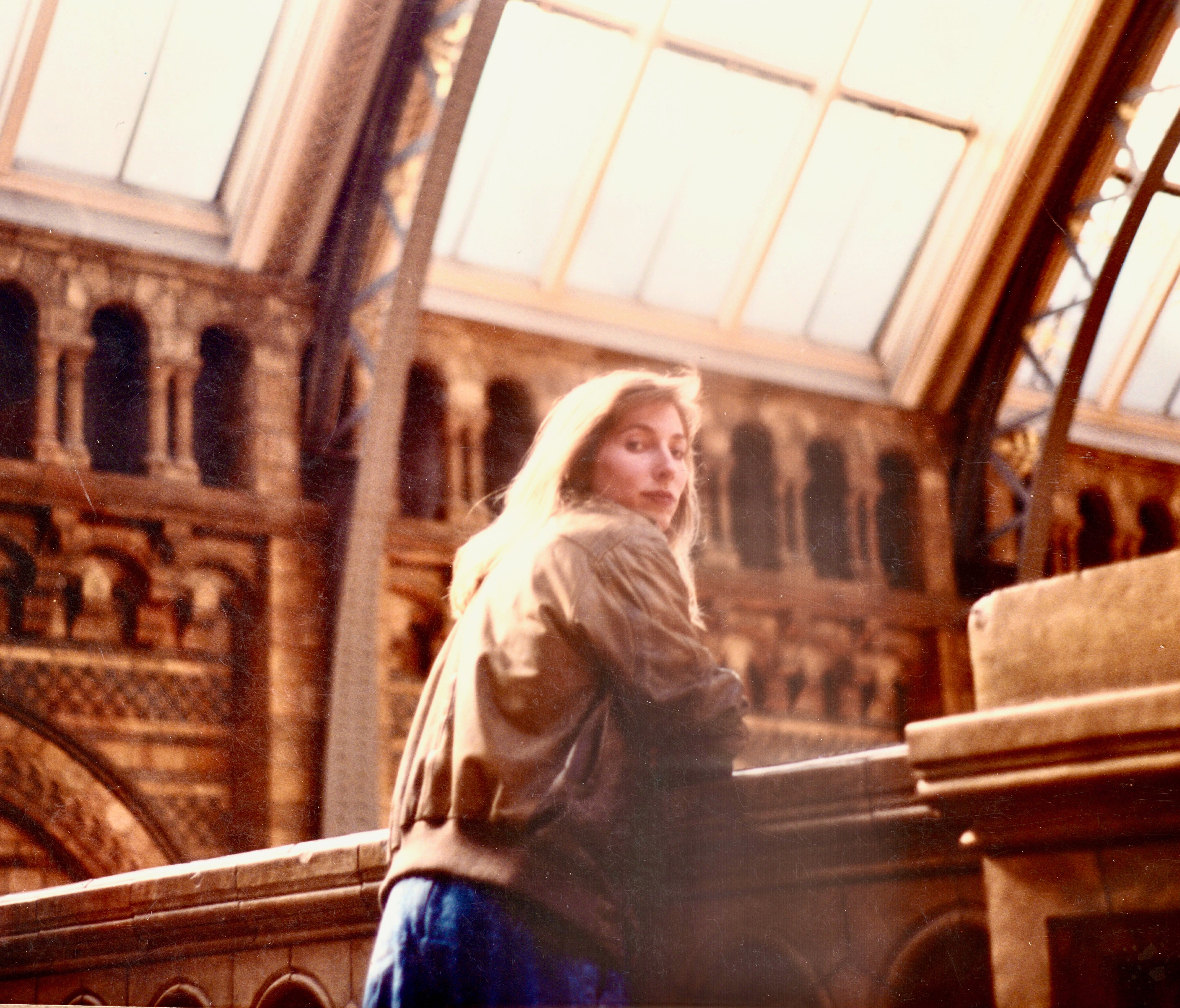
I tried my best to power through. After seeing the few sights my body would allow, I took a cab back to Gerald’s. I’d learned my lesson. Not having to tackle the Tube again far outweighed the expense of a cab ride. My driver was broad-shouldered with rough features. He took me on a circuitous route back to the flat while keeping up an unsavory commentary about how the city had gone to hell because of this, that, and the other thing. I was aware that he was racking up the charges, but I said nothing. Everything looked beautiful to me, even the ugliness.
The driver pulled up in front of Gerald’s. I paid him an exorbitant fare and got out of the car. In order to balance myself on the rough pavement, I had to lean on my cane, which meant only my left hand was free to receive the change the driver gave me. I clutched at the pounds and shillings, but half of them dropped through my numb fingers. The cabbie chuckled. Then the rest of the money fell out of my hand that couldn’t detect it was there.
“Oi, what’s wrong with you? Scared of dough?” the cabbie said. I bent down and scooped up the money with my right hand. I straightened up, blushing.
“I don’t have any feeling in this hand,” I said to the cabbie as I pointed to my left. My words had a bite behind them. He shrugged and drove away as I stuffed the pounds into my fanny pack.
That night I lay in the dark feeling surprisingly happy. Despite the difficulty I’d encountered, I’d gotten around and had managed to enjoy myself for at least part of the day. I remembered the July 4th stroke club celebration when I’d talked about looking forward to being independent sometime in an uncertain future.
There, in another country, tackling obstacles and taking on what life had thrown my way, I felt my Independence Day had arrived. From somewhere down below, a woman’s voice reverberated through the narrow street singing a haunting rendition of “Danny Boy.” The feeling I’d been seeking all day washed over me in a moment of pure bliss.
The next night, Gerald and I were having a drink in his library. His was high-end scotch, mine was sweet port. I was a lightweight when it came to alcohol, and after half a glass I was feeling pleasantly buzzed.
Gerald was entertaining me with stories about a film project he’d worked on that was rife with intrigue and chaos. It was good to be talking about the creative, crazy business I loved that now felt so inaccessible.
“Even though the camera operator was a wanker, I almost felt sorry for him when he walked in on his girlfriend having a good bonk with one of the extras,” Gerald said.
I caught his drift, but just to be sure I asked, “Bonk?”
“Shag. You know…fuck.” We laughed. I loved sipping that port. I loved hearing Gerald’s accent. Something familiar and unwanted came over me.
“Well, you know what, Gerald?” I said mischievously.
“What?” Gerald’s smile was lit by the scotch.
“I haven’t had a good bonk in a long time…so….?” I looked at him naughtily.
I heard the words as they escaped my lips and desperately wished I could take them back. Who was this desperate character who pathetically simpered and flirted, who knew my human vulnerability and used it to set up repeated humiliations? I hated her.
“Oh!” Gerald inhaled sharply. His eyes went wide for a flickering second. The look on his face was embarrassment tinged with pity. He opened his mouth to say something, but I cut him off with a guffaw.
“Oh God, I’m joking, Gerald!” I said, putting on a good show. “I’m obviously in no condition to bonk.”
Now off the hook, Gerald offered the proper encouragement. “You’re a fantastic girl,” he said. “Don’t ever let yourself think you’re not.”
I wanted to add: “But no longer bonkable.” Instead, I swallowed the last of my drink and held out my glass for Gerald to pour me another. He was happy to oblige. I’d saved the moment.
For the rest of my visit, I transferred my longing for connection to the city itself. When I left London, the pain and yearning in my heart felt like I’d left a true love behind.

Oh Elizabeth, I SO get this! When we’re in a place of grieving what we can no longer do, who we can no longer be, sometimes we need to shake things up in a big way just to feel alive again! How exhausting and exhilarating your London adventure sounds. As usual, you write with such honesty, even sharing your need to feel alluring again. For different but universal reasons, I so relate to your story. Many thanks for being so courageous, both in London and her on the page. 😍
I always look forward to your thoughts, Rosemary. Thank you. 🙏 It was quite an adventure. Looking back, I’m amazed that I took that trip. So many years have passed since then, but these days London is calling again!